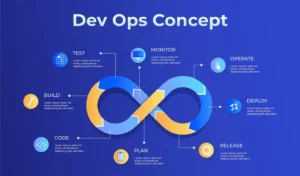
DevOps continues to shape how organizations build, secure, deploy, and operate software. In 2026, the discipline is moving beyond basic automation: teams are combining AI-assisted delivery, platform engineering, software supply-chain security, observability, and sustainable cloud operations to improve reliability and developer productivity.
DevOps Becomes AI-Assisted and Governed
AI is now helping teams generate pipeline configurations, summarize incidents, identify anomalies, improve test coverage, and recommend remediation steps. However, AI-generated changes still require human review, testing, access controls, and auditability. The strongest teams treat AI as a productivity and decision-support layer rather than an unsupervised replacement for engineering judgment.
- AI-assisted CI/CD: Faster failure analysis, test prioritization, and deployment recommendations.
- Intelligent operations: Correlation of logs, metrics, traces, events, and service dependencies.
- Human oversight: Approval gates, secure credentials, change tracking, and rollback plans for high-impact actions.
AI Tools for DevOps in 2026
AI tools are becoming practical assistants across the DevOps lifecycle. They can help teams write and review infrastructure code, improve pipelines, investigate incidents, summarize telemetry, and identify risks before deployment. The best results come from combining these tools with strong engineering practices, reliable data, and human approval for production changes.
- AI coding assistants: Help generate scripts, pipeline definitions, test cases, and infrastructure-as-code suggestions. Engineers should review generated code for security, correctness, licensing, and operational impact.
- AI-powered observability and AIOps: Correlate logs, metrics, traces, events, and alerts to reduce noise and support faster incident investigation.
- Intelligent CI/CD platforms: Assist with test selection, build-failure analysis, deployment risk assessment, and release recommendations.
- Security and code-review assistants: Detect insecure patterns, exposed secrets, vulnerable dependencies, and policy violations earlier in the development workflow.
- ChatOps and incident assistants: Summarize incidents, retrieve runbook information, draft updates, and suggest remediation steps while keeping approval controls in place.
When adopting AI tools, teams should protect confidential code and operational data, define access permissions, monitor output quality, and keep an audit trail. AI should support DevOps decisions—not bypass testing, change management, security reviews, or incident-response accountability.
DevSecOps and Software Supply-Chain Security
Security is embedded throughout the software lifecycle in 2026. Organizations are strengthening dependency management, container security, identity controls, secrets handling, and artifact integrity instead of waiting until release time to scan applications.
- Software bills of materials and provenance records for important releases.
- Dependency, code, container, infrastructure, and API scanning in automated workflows.
- Short-lived credentials, least-privilege access, signed artifacts, and protected deployment environments.
- Continuous monitoring for vulnerabilities and suspicious runtime behavior.
Platform Engineering and Internal Developer Platforms
Platform engineering is becoming a practical way to scale DevOps across larger organizations. Internal developer platforms provide approved templates, environments, deployment workflows, observability, and security controls through self-service interfaces. This reduces repeated operational work while allowing developers to focus on delivering business features.
In 2026, successful platforms are measured by developer experience, adoption, delivery speed, reliability, and the reduction of unnecessary cognitive load—not simply by the number of tools they include.
Observability, SRE, and Resilience
Modern teams use logs, metrics, traces, profiles, events, and business signals together to understand system behavior. Open standards and consistent telemetry make it easier to operate distributed applications across cloud, hybrid, and edge environments.
- Service-level objectives and error budgets linked to business priorities.
- Faster incident detection, response, and root-cause investigation.
- Reliability testing, disaster-recovery exercises, and carefully controlled chaos experiments.
- Runbooks and automated remediation with clear safety limits.
GitOps and Everything as Code
Git remains a central source of truth for application delivery and infrastructure management. Infrastructure, configuration, security policies, dashboards, and deployment definitions can be reviewed, versioned, tested, and rolled back through code-based workflows.
GitOps practices help teams reduce configuration drift and create a clear audit trail. They are most effective when repositories are protected, secrets are handled securely, and production changes include appropriate review and policy checks.
Multi-Cloud, Kubernetes, and Edge Operations
Organizations continue to use a mix of public cloud, private infrastructure, managed services, and edge locations. DevOps teams must standardize delivery without pretending that every environment is identical. Kubernetes and related cloud-native tools remain important, but teams should choose them based on operational needs rather than trend alone.
- Reusable infrastructure modules and policy controls across environments.
- Reliable deployment and rollback processes for distributed workloads.
- Security and observability designed for remote and resource-constrained edge locations.
- Cost, performance, availability, and data-residency considerations in architecture decisions.
Developer Experience and Continuous Delivery
DevOps in 2026 places greater emphasis on reducing friction for developers. Standardized pipeline templates, preview environments, fast feedback, clear ownership, and accessible internal documentation help teams deliver safely without making every developer become an infrastructure specialist.
Metrics should cover both delivery and outcomes, including lead time, deployment frequency, change failure rate, recovery time, reliability, security findings, and developer satisfaction.
Sustainable and Cost-Aware DevOps
Cloud efficiency is now connected to both financial and environmental responsibility. Teams are reducing waste by right-sizing resources, scheduling non-production environments, optimizing builds and tests, selecting suitable architectures, and monitoring the cost and energy impact of workloads.
DevOps Roles and Skills in 2026
Career paths continue to expand across DevOps engineering, platform engineering, site reliability engineering, cloud security, observability, and AI/ML operations. Professionals should develop a balanced skill set that combines technical depth with collaboration and problem-solving.
- Linux, networking, Git, scripting, and secure software delivery.
- CI/CD, infrastructure as code, containers, Kubernetes, and cloud platforms.
- Observability, SRE practices, incident response, and resilience engineering.
- Identity, supply-chain security, policy as code, and compliance automation.
- Responsible use of AI tools, including verification, privacy, and governance.
Conclusion: DevOps Is a Responsible Delivery Model
In 2026, DevOps is more than pipelines and infrastructure. It is a coordinated approach to delivering software quickly while protecting users, improving reliability, controlling cost, and supporting developers. Organizations and professionals that combine automation with security, observability, platform thinking, and responsible AI adoption will be better prepared for the next stage of digital delivery.